The 5-day Marangu Route (“Coca-Cola Route”) is the shortest, most affordable, and only route offering hut accommodation on Mount Kilimanjaro. It involves a rapid ascent via a straightforward path, passing through rainforest and alpine moorland. While popular, the fast 5-day schedule results in a lower, approximately 27% success rate compared to longer itineraries.


Upon arrival at Kilimanjaro International Airport (KIA), Tanzania’s gateway to the famed mountain Kilimanjaro, you’ll be greeted by the sight of Africa’s highest peak majestically dominating the horizon. After clearing customs and immigration formalities, you’ll likely be met by our representative who will handle your luggage and transfer arrangements.
The drive from Kilimanjaro Airport to Moshi will take about an hour, depending on traffic conditions, arriving at the hotel, you’ll check in, freshen up after your flight, and have a briefing with your guides. This is a good time to ask any questions you have about the climb, the route, and the gear you’ll need. The guides will also go over safety procedures and what to expect in the coming days.
Dinner
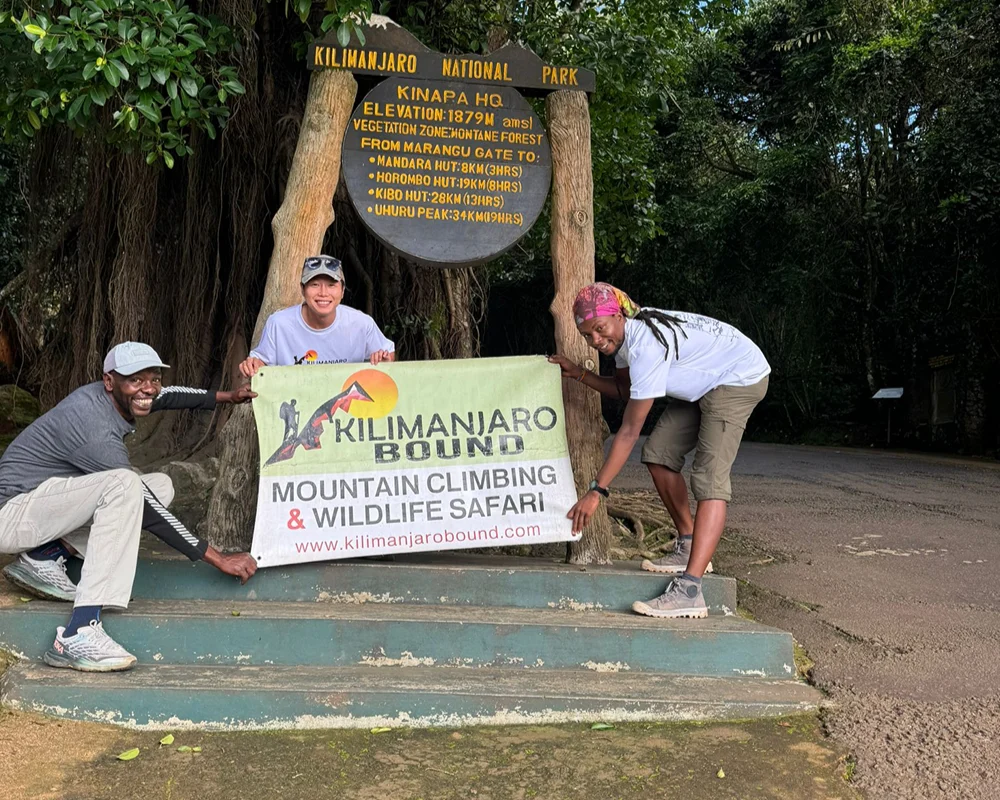
Morning: After breakfast in Moshi (approx. 1-hour drive), you will be transferred to the Marangu Gate, the main entrance to Kilimanjaro National Park. Here, you’ll complete park formalities and meet your Kilimanjaro guide and porters.
Mid-day: Your trek begins through the lush rainforest. The trail is well-maintained and gently ascends through towering eucalyptus trees, ferns, and various species of birds. Keep an eye out for black and white Colobus monkeys! The humidity can be high in this zone, and the trail can be little muddy, especially during the rainy seasons (April-May and November-December).
Afternoon: You’ll arrive at Mandara Hut, a collection of wooden A-frame huts that can accommodate around 60 climbers in bunk beds. After settling in, you can take a short optional excursion to the Maundi Crater for stunning views of the surrounding landscape, including Northern Tanzania and Kenya, if the weather is clear.
Evening: Dinner will be served in a communal dining hut. This is a great opportunity to meet fellow climbers from around the world. Your guide will provide a briefing for the next day’s trek.
Accommodation: Mandara Hut (dormitory-style bunk beds with mattresses). Flush toilets and solar lighting are available.
3-4 hours
840 meters / 2,760 feet
Montane Forest
Dinner
Mandara Hut
Morning: After breakfast, you’ll leave the rainforest behind and begin your ascent into the heathland zone. The vegetation gradually changes to low shrubs, giant heathers, and the unique giant lobelias. The views of Kibo and Mawenzi peaks become increasingly impressive on a clear day.
Mid-day: You’ll stop for a packed lunch along the trail, enjoying the open moorland scenery.
Afternoon: You’ll arrive at Horombo Hut, the largest of the huts on the Marangu route, with a capacity of around 120 beds. This camp is known for its relatively comfortable facilities and is a popular stop for both ascending and descending climbers. You might start to feel the effects of the increasing altitude here.
Evening: Dinner will be served, and your guide will conduct an important briefing about the summit attempt, including what to expect and how to manage the high altitude.
Accommodation: Horombo Hut (dormitory-style bunk beds with mattresses and pillows). Flush toilets and solar lighting are available.
5-6 hours
1,020 meters / 3,340 feet
Heather
Dinner
Horombo Hut

Morning: After breakfast, you’ll continue your ascent into the stark and barren alpine desert zone. The landscape transforms dramatically, with sparse vegetation and volcanic rocks. You’ll pass the “Last Water Point” (at around 4,130m / 13,550 ft), so ensure you have enough water for the rest of the day and the summit climb.
Mid-day: You’ll have a packed lunch en route, surrounded by the dramatic lunar-like scenery of the saddle between Kibo and Mawenzi peaks.
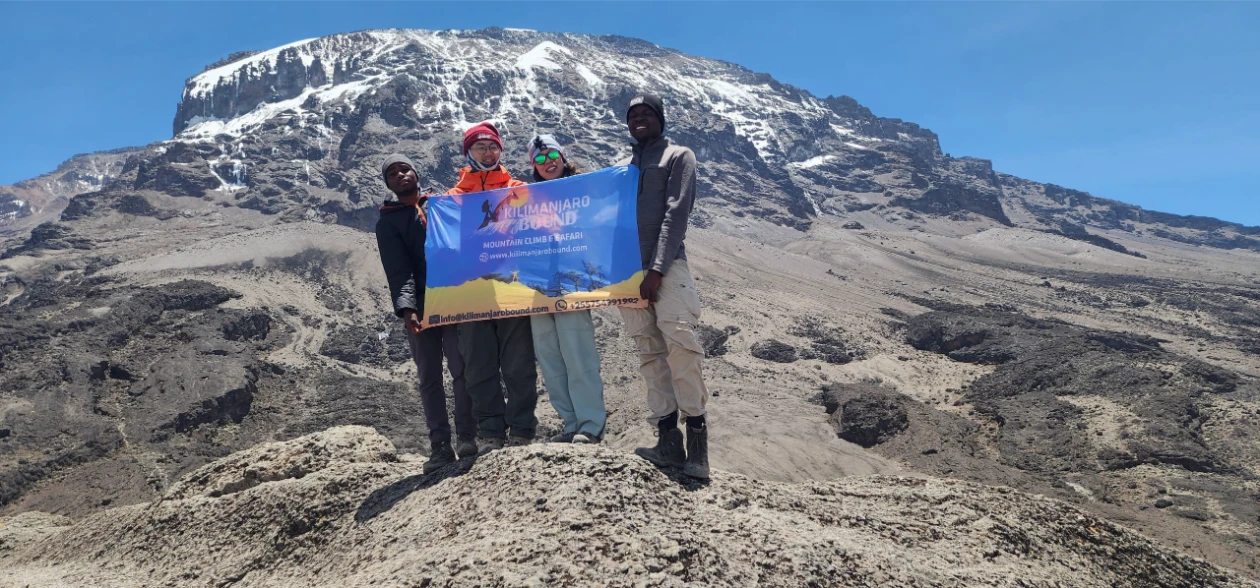
Afternoon: You’ll arrive at Kibo Hut, a basic stone structure with limited facilities. This is the base camp for the summit attempt. It’s crucial to rest and hydrate well here, as the summit night will be long and challenging.
Evening: An early dinner will be served, and you should try to get some sleep before the midnight wake-up call for the summit push.
Accommodation: Kibo Hut (basic dormitory-style bunk beds with thin mattresses). Pit latrines are the only toilet facilities. There is no running water here.
5-6 hours
980 meters / 3,220 feet
Alpine Desert
Dinner, Breakfast
Kibo Hut
Midnight – Early Morning: You’ll be woken up around midnight for a light snack and preparations for the summit climb. This is the most demanding part of the trek. You’ll hike in the darkness, using headlamps, on steep and loose scree. The air is thin, and temperatures can drop significantly below freezing. The pace will be slow and steady (“pole pole” in Swahili).
Sunrise: You’ll aim to reach Gilman’s Point (5,685m / 18,650 ft) on the crater rim around sunrise, where you’ll be rewarded with breathtaking views. After a short rest and photos, you’ll continue along the crater rim for another 1-2 hours to Uhuru Peak (5,895m / 19,340 ft), the “Roof of Africa”!
Summit: Take time to celebrate your incredible achievement, take photos, and soak in the panoramic views. Be mindful of the altitude and don’t stay too long.
Descent: You’ll begin your descent back to Kibo Hut for a short rest and lunch. Afterward, you’ll continue the long descent down to Horombo Hut. This part can be tough on the knees, so trekking poles are highly recommended.
Evening: You’ll arrive at Horombo Hut, exhausted but exhilarated. A well-deserved dinner will be served.
Accommodation: Horombo Hut (dormitory-style bunk beds).
5-8 hours
2,175 meters / 7,140 feet (descent)
Alpine Desert
Dinner
Horombo Hut
Morning: After breakfast, you’ll begin your final descent. The trek takes you back through the moorland and then into the lush rainforest. The lower altitudes will feel significantly warmer and the increased oxygen level will be noticeable.
Mid-day: You’ll have a packed lunch along the way.
Afternoon: You’ll arrive at the Marangu Gate, where you’ll be presented with your summit certificate! Your transport will be waiting to take you back to your hotel in Moshi for a well-deserved rest and celebration.
5-7 hours
1,860 meters / 6,100 feet
Heather
Dinner
Transfer to Kilimanjaro Airport and Fly out
Price per person based on group size. All prices in USD
Price per person
PAX
1 PAX
2 PAX
3 PAX
4 PAX
5 PAX
6 PAX
Price
Price per person
PAX
1 PAX
2 PAX
3 PAX
4 PAX
5 PAX
6 PAX
Mandara Hut is the first overnight stop on the Marangu Route of Mount Kilimanjaro, located at approximately 2,700 meters (8,858 feet) above sea level. The hut is situated within the lush rainforest zone on the southeastern slopes of the mountain.
The trek to Mandara Hut passes through dense montane forest filled with giant trees, ferns, moss-covered vegetation, and diverse birdlife. Climbers may also encounter blue monkeys and colobus monkeys along the trail, making the journey especially scenic and enjoyable.
Mandara Hut provides trekkers with a comfortable introduction to Kilimanjaro climbing before continuing toward higher camps such as Horombo Hut. The cooler mountain temperatures and forest atmosphere create a relaxing overnight environment after the first trekking day.
Accommodation at Mandara Hut consists of wooden A-frame mountain huts with shared dining and bathroom facilities. Nearby attractions include the Maundi Crater, which offers beautiful views of the surrounding landscape and, on clear days, distant views toward Kenya.
Horombo Hut is a popular mountain hut located on the Marangu Route of Mount Kilimanjaro at approximately 3,720 meters (12,205 feet) above sea level. It serves as both an overnight stop and an important acclimatization point for climbers ascending and descending the mountain.
The hut is positioned within the moorland zone, surrounded by rolling hills, giant groundsels, and volcanic landscapes. The area offers beautiful views of both Kibo Peak and Mawenzi Peak, creating one of the most scenic overnight locations on the Marangu Route.
Many climbers spend an extra night at Horombo Hut for acclimatization before continuing toward Kibo Hut. The gradual adjustment to altitude helps improve summit success rates while allowing trekkers time to rest and explore the surrounding landscape.
Accommodation at Horombo Hut includes dormitory-style sleeping huts with shared dining and bathroom facilities. The camp is larger and more social than many other Kilimanjaro camps due to the number of trekkers using the Marangu Route.
Kibo Hut is a high-altitude mountain hut located on Mount Kilimanjaro at approximately 4,720 meters (15,485 feet) above sea level. It serves as the main summit camp for climbers using the Marangu Route and Rongai Route before their final ascent to Uhuru Peak.
The hut is situated in the alpine desert zone between the peaks of Kibo and Mawenzi. The surrounding landscape is harsh and rocky, with volcanic terrain, cold temperatures, and thin air creating a true high-mountain environment. Vegetation is almost nonexistent at this altitude, and conditions are often windy and extremely cold, especially during the night.
Climbers usually arrive at Kibo Hut in the afternoon, rest for a few hours, and begin their summit attempt around midnight. The camp plays a critical role in allowing trekkers to prepare physically and mentally for the demanding climb to Gilman’s Point and Uhuru Peak.
Accommodation at Kibo Hut consists of dormitory-style mountain huts with bunk beds and shared facilities. Despite the simple setup, the hut provides important shelter for climbers before the summit ascent.
Horombo Hut is a popular mountain hut located on the Marangu Route of Mount Kilimanjaro at approximately 3,720 meters (12,205 feet) above sea level. It serves as both an overnight stop and an important acclimatization point for climbers ascending and descending the mountain.
The hut is positioned within the moorland zone, surrounded by rolling hills, giant groundsels, and volcanic landscapes. The area offers beautiful views of both Kibo Peak and Mawenzi Peak, creating one of the most scenic overnight locations on the Marangu Route.
Many climbers spend an extra night at Horombo Hut for acclimatization before continuing toward Kibo Hut. The gradual adjustment to altitude helps improve summit success rates while allowing trekkers time to rest and explore the surrounding landscape.
Accommodation at Horombo Hut includes dormitory-style sleeping huts with shared dining and bathroom facilities. The camp is larger and more social than many other Kilimanjaro camps due to the number of trekkers using the Marangu Route.
There are no results matching your search
Everything you need to know about what makes this route special
This itinerary offers minimal time for acclimatization, significantly increasing the risk of altitude sickness. Be sure to communicate any symptoms to your guide immediately.
A good level of fitness and endurance is required for this fast-paced trek.
The 5-day Marangu route has a lower summit success rate compared to longer routes.
As you ascend and descend along the same path, the scenery will be the same on both legs of your journey, offering less variety compared to other routes.
.
Choose the best season for your Mount Kilimanjaro Climbing adventure
Clear & Warm
21–27°C base / -7 to -29°C summit
High
Premium
The warmest months on the mountain, with excellent visibility. Expect generally clear skies in the mornings and evenings; clouds may appear during the day with occasional brief showers.
Clear & Cold
15–20°C base / -10 to -20°C summit
Very High
Premium
The probability of rain is minimal, skies are mostly clear, and the visibility is unparalleled. July and August are the busiest months on the mountain, with crowds thinning in September and even more so in October.
Variable — occasional showers
18–25°C base / -10 to -20°C summit
Low to Moderate
Standard
Early October is still stable, but by November, less stable weather patterns can bring rain every day for a short period. March begins with a short dry window, but by mid-March the long rains begin.
Because the 5-day route skips the extra acclimatization day at Horombo Hut, it is physically demanding. It’s highly recommended for those who are already well-conditioned or have recently spent time at high altitudes.
When climbing the Marangu Route, you have two primary accommodation options: the classic Standard Huts and the newly upgraded VIP (Luxury) Huts. While both provide a roof over your head, the experience, privacy, and amenities differ significantly.
Many trekkers don’t realize there is a choice between the Standard Huts and the newly available VIP (Luxury) Huts.
The standard huts are the traditional choice for Marangu trekkers. Think of these as mountain dormitories—functional, social, and rugged.
The VIP or “Luxury” huts are designed for trekkers who want the hut experience without the “hostel” atmosphere. These are limited in number and often require early booking.
Technically, it is the “easiest” because the paths are well-defined and the incline is gradual. However, physically, it is one of the hardest because you have only 4 days to reach 5,895m. Most people fail because of altitude sickness, not physical exhaustion.
For the 5-day trek, the success rate is roughly 50%. By comparison, the 6-day version (which adds one acclimatization day) jumps to over 65-70%.
In a 5-day itinerary, you do skip the acclimatization day at Horombo Hut. You will hike directly from Horombo (3,720m) to Kibo Hut (4,700m) on Day 3 and attempt the summit that same night.
You will stay in A-frame wooden huts with bunk beds and mattresses.
No. This is the only route where you don’t need a tent. You only need a warm 4-season sleeping bag.
Generally, no. Some huts have solar lights, but you cannot rely on them to charge devices. Bring a high-capacity power bank. Mobile signal is spotty but often available at Horombo and parts of the Marangu Gate.
Real experiences from real adventures who’ve explored Tanzania with us


 Verified
 Verified
 Verified
 Verified
 Verified
 Verified
 Verified
 Verified
 Verified
 Verified
Let our travel specialists create a personalized itinerary just for you
There are no results matching your search